Temperature
Higher ambient temperature may increase fragrance volatility and diffusion; cooler conditions may slow release.

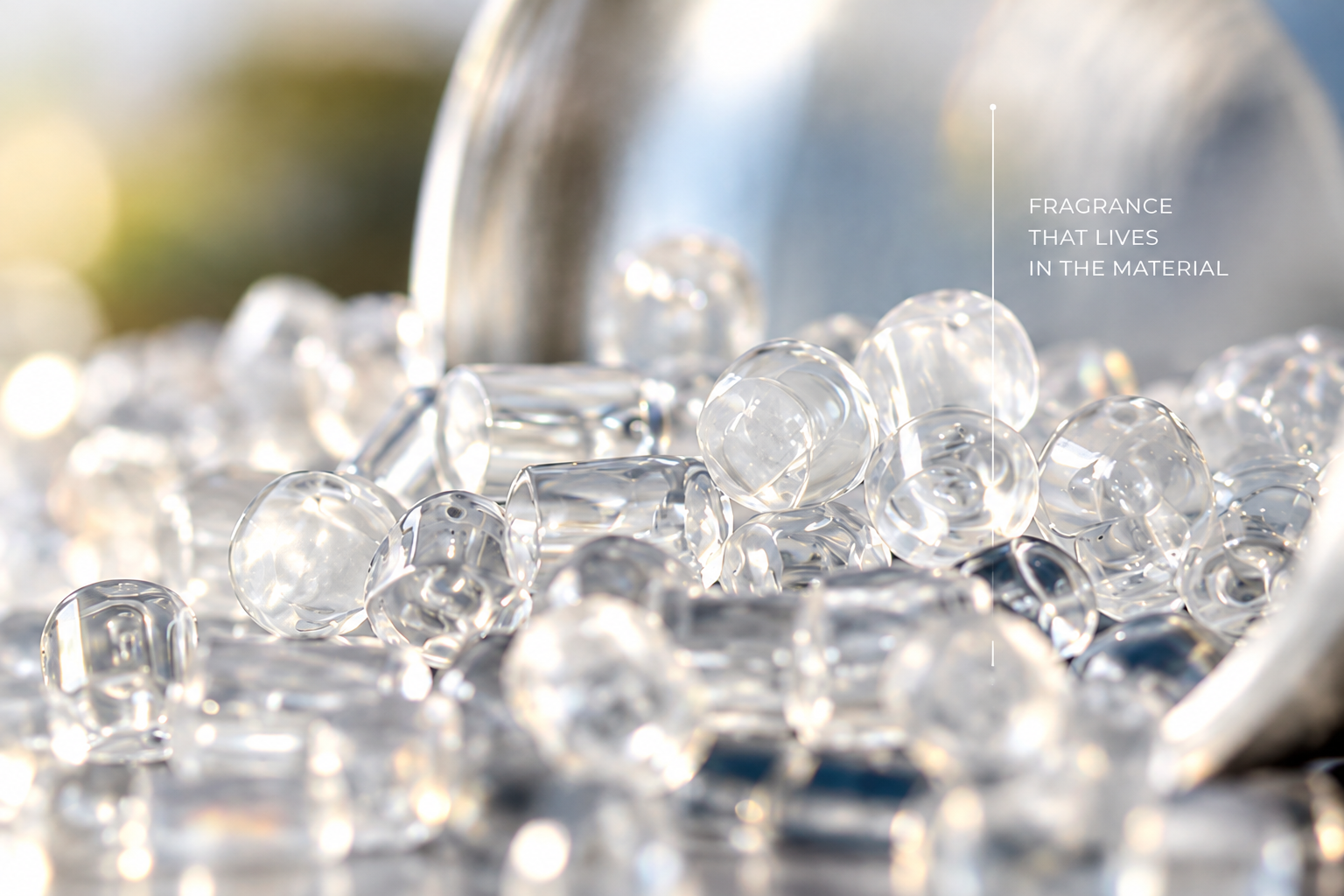
HOPCP® integrates fragrance into engineered polymer composites, enabling dry-to-the-touch solid components designed for progressive, application-specific olfactory release.
↗Explore the technologyConventional fragrance products often rely on reservoirs, impregnated substrates or surface coatings. HOPCP® uses an engineered polymer matrix in which fragrance components are incorporated throughout the material.
This produces a dry-to-the-touch solid platform that can combine the geometry and handling characteristics of a polymer component with progressive olfactory release. The release profile depends on the formulation, component geometry and conditions of use.
Fragrance molecules migrate through the composite matrix and diffuse into the surrounding environment. Their release is influenced by the physicochemical interaction of polymer and fragrance, as well as the external environment.
Conceptual illustration; not a depiction of proprietary material structure or processing parameters.
Higher ambient temperature may increase fragrance volatility and diffusion; cooler conditions may slow release.
Depending on the selected material system, moisture may influence olfactory release behaviour.
Some configurations can respond to compression, flexing or handling.
Surface area, thickness and surrounding air exchange affect fragrance transfer and dispersion.
Depending on the formulation, fragrance content may reach up to 50%. High fragrance concentrations can be incorporated into suitable composites, subject to compatibility and application requirements.
Material selection and component design allow fragrance behaviour to be adapted to targeted use conditions.
Fragrance delivery can be provided without a separate liquid reservoir.
Functional inserts, cards and shaped components can be engineered for product integration.
Selected fragrance families and functional additives can be assessed for their suitability in the polymer platform.
Concept, formulation, prototyping and industrial manufacturing can be considered as a connected engineering workflow.
In a conventional air freshener, the fragrance and its delivery support often remain separate design considerations. The perfumed liquid may be stored in a reservoir, absorbed into a pad or applied to a substrate. Each approach creates its own constraints in packaging, leakage management, assembly and evaporation behaviour.
With HOPCP®, the fragrance-bearing material is also a shaped solid component. This makes it possible to integrate scent delivery within the geometry of a product, explore new placements and reduce reliance on a separate container for liquid fragrance. It does not mean that every formulation performs identically: chemical compatibility, storage conditions and intended lifetime must be evaluated for each design.
Our engineering objective is to define a useful release profile for the application rather than assume that the most intense initial fragrance is always the best outcome. Performance is evaluated over time and under relevant use conditions.
Material and product engineering must be developed together. A selected olfactory composition is assessed for its compatibility with the polymer platform, while the final part is designed around its required size, shape, handling and operating environment. Design choices influence fragrance transfer, perceived intensity and feasibility of industrial production.
Choose the desired fragrance character and evaluate suitability for incorporation in the polymer system. Not every fragrance behaves equally in every matrix.
Shape, thickness, exposed area and installation location contribute to the behaviour of the finished fragrance-delivery component.
Consider temperature variations, airflow, storage, handling and desired consumer experience when defining acceptance criteria for a new product.
Moulded fragrance inserts and components conceived for demanding, variable environments.
Wardrobe, home air-care and consumer applications using integrated fragrance material.
Scented inserts, packaging components and promotional objects.
Selected solutions for professional and hospitality settings, developed for specific needs.
By integrating fragrance into a designed material system, HOPCP® creates opportunities to limit unnecessary fragrance loss and optimize product architecture. Its environmental performance must be assessed for each formulation, product and lifecycle.
Research includes alternative polymer bases and the feasibility of improved recyclability or biodegradability. These are development objectives, not universal properties of every HOPCP® product.
All performance characteristics are formulation- and application-dependent.
Tell us about your application, technical requirements and manufacturing challenge.