Digital engineering
Define the tooling function, geometry and production requirements and evaluate whether additive manufacturing is appropriate.

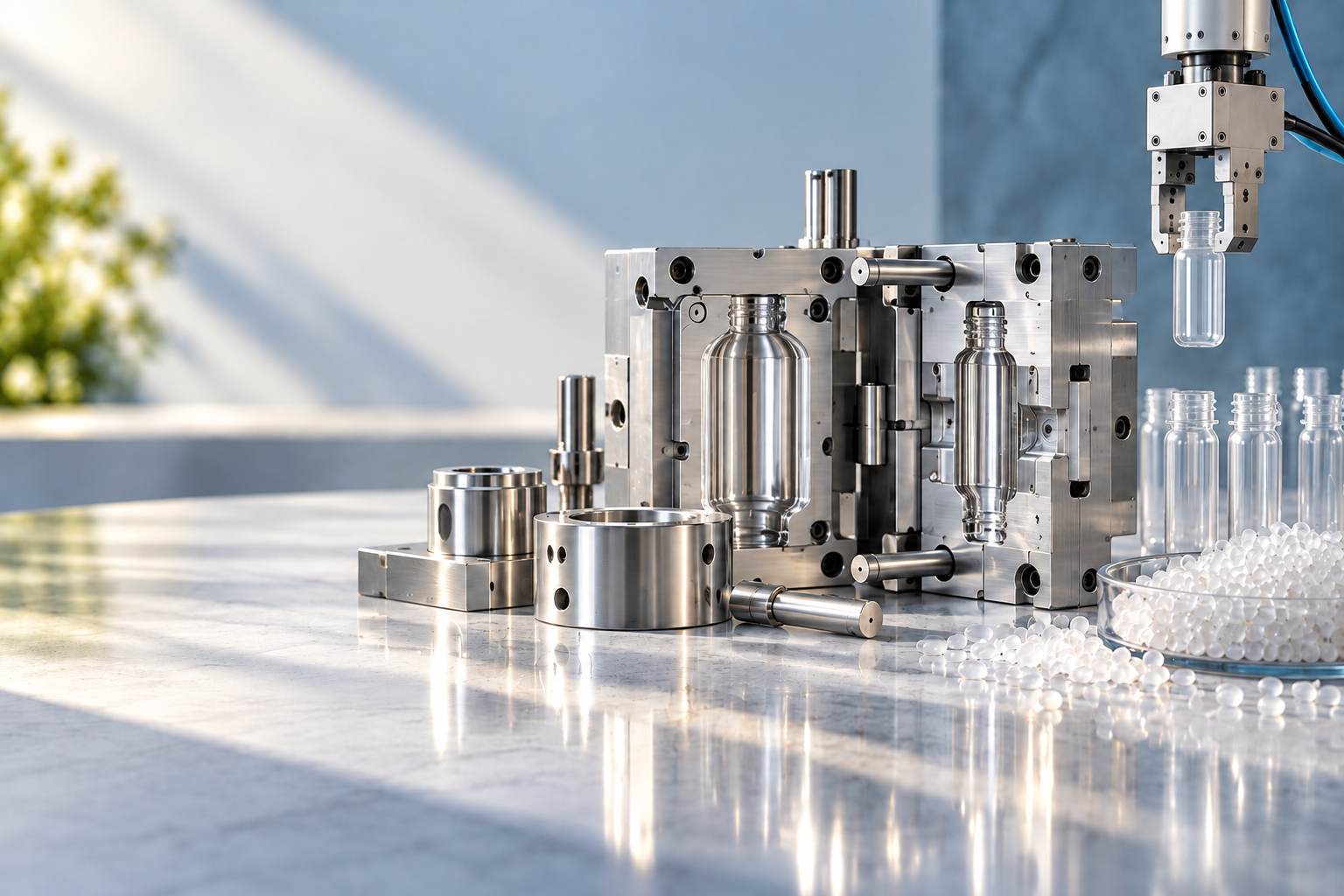
Selective Laser Melting creates complex metal tooling layer by layer from digital designs, opening up new possibilities for mould geometry, development and production engineering.
↗Explore the technologyDeveloping a new polymer component is not only a question of selecting the right material. The geometry must also be translated into a tool capable of producing the intended part with appropriate accuracy, repeatability and process conditions.
Traditional mould manufacturing uses machining and other established operations to produce the required cavities and mechanical features. Additive manufacturing offers a complementary approach by creating metal geometry layer by layer, enabling certain intricate features that can be challenging to achieve using subtractive methods alone.
SLM is relevant to Scent Emotions' broader technology portfolio because it connects the design of functional polymer products with the development of the tools used to manufacture them.
The process begins with a three-dimensional design prepared for additive manufacturing. In general SLM processes, a laser selectively melts regions of metal powder in successive layers to produce a consolidated component. Finishing, inspection and any required subsequent machining remain important parts of preparing a mould for use.
Define the tooling function, geometry and production requirements and evaluate whether additive manufacturing is appropriate.
Fabricate selected metal geometry additively using a powder-bed laser process.
Carry out the necessary post-processing and dimensional checks for the particular tool design.
Assess the finished mould or tooling component under the requirements of the intended production process.
Metal additive manufacturing can provide design freedom for selected mould components, including complex internal structures and geometries that would be difficult to machine directly. A common industrial application is the exploration of conformal cooling features, where suitable tooling designs may improve heat transfer around complex part shapes.
Benefits are not automatic. Surface quality, dimensional accuracy, material selection, machine capability, build orientation, post-processing and the total cost of the finished tool must be evaluated against conventional alternatives.
SLM should therefore be considered one manufacturing option within an engineering toolkit — selected when its specific capabilities serve the functional and economic objectives of a product.
Custom fragrance components require close coordination between part geometry, material behaviour and tooling feasibility. Bringing these considerations together during product development helps evaluate whether an idea can become a robust industrial component.
Our technology portfolio presents SLM alongside HOPCP® and ODOREX™ because innovation may involve a material, a chemical function or the way a part is made. Specific SLM production capabilities, performance figures and lead times should be confirmed for each proposed project.
Tell us about your application, technical requirements and manufacturing challenge.